QUICK ANSWER — What to Do Right Now
Your car won’t start? Start here: Check the battery first — it’s the cause in about 60% of no-start cases. If your battery is over 3 years old, it’s likely the culprit. Try a jump start — if the car starts and stays running, you probably just need a new battery ($120–$350 installed). If it starts but dies shortly after, suspect the alternator ($400–$900). If you hear a single loud click or rapid clicking with no engine crank, it’s likely the starter motor ($350–$1,100). Don’t panic — most no-start issues are electrical and fixable, not catastrophic engine failure.
Common Symptoms — What Your Car Is Telling You
Before we dive into causes, let’s decode what your car is actually saying when you turn the key or press the start button.
| Symptom | What It Sounds/Looks Like | Most Likely Cause |
|---|---|---|
| No sound, no lights, nothing | Complete silence. Dashboard is dead. | Dead battery, blown main fuse, or bad ignition switch |
| Rapid clicking noise | Click-click-click-click when you turn the key | Weak/dead battery (not enough juice to crank) |
| Single loud click, then silence | One CLICK and nothing else | Bad starter motor or starter solenoid |
| Lights work, but engine won’t crank | Dashboard lights up, radio works, but engine does nothing | Bad starter, starter relay, or immobilizer issue |
| Engine cranks slowly | Ruh-ruh-ruh — weak, sluggish cranking | Weak battery, corroded terminals, or bad connection |
| Engine cranks normally but won’t fire | Engine turns over fine but never starts | Fuel system issue, spark problem, or security system |
| Car starts, then dies immediately | Fires up, then stalls out | Failing alternator (not charging the battery) |
The 5 Most Common Causes of a No-Start Condition
1. Weak or Dead Battery (Most Common — ~60% of cases)
Why it happens: Car batteries typically last 3 to 5 years. In hot climates (Arizona, Texas, Florida), they may only last 41 months or less. In colder northern regions, they can last 58 months or longer. Modern vehicles with more electronics often skew closer to the 3-year mark.
Common signs:
- Rapid clicking when you turn the key
- Dim or flickering dashboard lights
- Power windows move slower than usual
- The car starts after a jump but won’t start again later
Typical cost (2026):
- DIY jump start: $0 (with jumper cables)
- Roadside assistance jump: $0–$100 (free with AAA or insurance plans)
- Standard battery replacement (lead-acid): $120–$200
- Enhanced flooded or AGM battery: $200–$350
- Luxury/European vehicles (BMW, Mercedes, Audi) with coding: Add $50–$150 for dealer programming
💡 Pro Tip: AGM (Absorbent Glass Mat) batteries cost 40–100% more than standard batteries but can last up to 10 years and recharge faster. If your car has start-stop technology, you must use an AGM battery — standard batteries won’t work and can cause electrical issues.
2. Bad Starter Motor
Why it happens: The starter motor converts electrical energy from the battery into mechanical energy to crank the engine. Over time, the starter’s internal components wear out, or the starter solenoid fails. On average, starters last 80,000–150,000 miles, but heat and electrical issues can shorten their life.
Common signs:
- A single loud click when you turn the key, but the engine doesn’t crank
- Intermittent starting — works sometimes, fails others
- The engine cranks very slowly even with a good battery
- You hear a grinding noise when trying to start
Typical cost (2026):
- Parts only: $80–$400
- Labor: 1–3 hours at $100–$200/hour
- Total replacement: $350–$1,100
- Midsize sedan (Camry, Accord): $300–$600
- Luxury/European vehicles: $700–$1,100
💡 Pro Tip: A bad starter can mimic battery symptoms perfectly. If you’ve replaced the battery and still have issues, the starter is your next suspect. Before replacing either, have both tested at an auto parts store — most offer free testing.
3. Failing Alternator
Why it happens: The alternator generates electrical current to replace what the starter draws from the battery during startup and powers the vehicle’s electrical systems while the engine runs. When the alternator fails, the battery drains while driving — and eventually, there’s not enough juice to start the car.
Common signs:
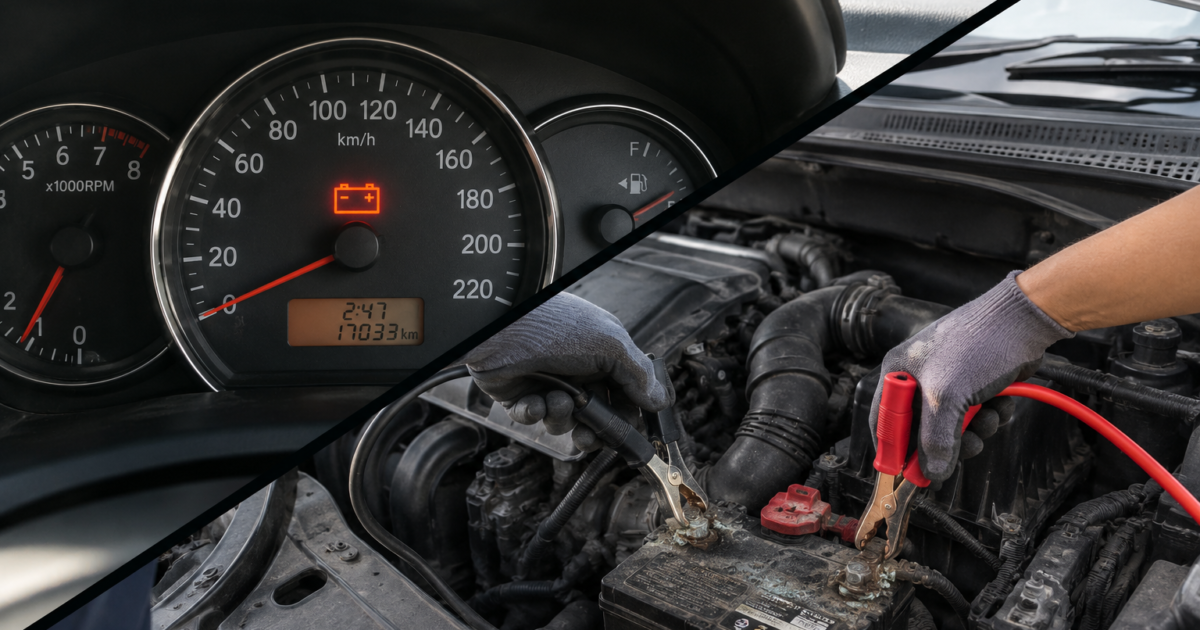
- Battery warning light on the dashboard (this indicates charging system issues)
- Headlights dim at idle and brighten when you rev the engine
- Car dies while driving or stalls at stoplights
- Repeated dead batteries despite recent replacements
Typical cost (2026):
- Economy cars: $450–$700 total
- Most vehicles: $400–$900
- Luxury/performance models: $900–$1,400+
- Diesel trucks (250-amp alternators): $500–$700 (new) or $250–$350 (professional rebuild)
- Dealership labor: $150–$200 per hour
💡 Pro Tip: If your car dies while driving and won’t restart, it’s likely the alternator — do not continue driving. The car will stall, and you’ll lose power steering and brakes. Pull over safely and call for a tow.
4. Loose or Corroded Battery Terminals
Why it happens: Sometimes the problem is simple — poor electrical connection between the battery and the cables. Corrosion (that white, crusty buildup) acts as an insulator, preventing electricity from flowing. Loose connections can cause intermittent starting issues that frustrate even experienced drivers.
Common signs:
- Intermittent starting — works one day, fails the next
- Flickering dashboard lights
- Car starts after wiggling the battery cables
- Visible white, blue, or green crusty buildup on terminals
Typical cost (2026):
- DIY cleaning: $0–$10 (baking soda, water, wire brush)
- Shop cleaning/tightening: $0–$50 (many shops do this for free with other service)
💡 Pro Tip: When disconnecting the battery, always remove the negative (black) cable first, then the positive (red). When reconnecting, install the positive first, then negative. This prevents sparks and electrical shorts.
5. Key Fob or Immobilizer Issues (Modern Cars)
Why it happens: Many newer vehicles (2015+) rely on electronic security systems. If the system doesn’t recognize your key fob, it won’t allow the engine to start. This is a common but often overlooked cause.
Common signs:
- Car does nothing when you press the start button
- Security light flashing on the dashboard
- Works with the spare key but not the primary
- Dashboard message like “Key Not Detected” or “Immobilizer Active”
Typical cost (2026):
- Key fob battery replacement: $5–$20 (DIY)
- Key fob replacement (dealer): $150–$500
- Immobilizer reprogramming: $50–$200
Step-by-Step Diagnostic Process
Follow this process to pinpoint the exact cause. Do not skip steps — this will save you time and money.
🔧 STEP 1: Safety First
Before you pop the hood:
- Wear safety glasses and gloves — batteries contain sulfuric acid, which can cause burns
- Remove all metal jewelry — rings, watches, and bracelets can cause dangerous short circuits
- Work in a well-ventilated area — batteries emit hydrogen gas, which is explosive
- Never smoke or create sparks near the battery
- Ensure the engine is off and all electrical components are shut off
🔧 STEP 2: The Headlight Test
Turn on your headlights and try to start the car:
- Headlights stay bright, engine doesn’t crank → Likely starter or starter relay issue
- Headlights dim significantly or go out → Dead or weak battery
- Headlights work, engine cranks but won’t start → Fuel or spark issue
🔧 STEP 3: Check Battery Terminals
- Open the hood and inspect the battery terminals
- Look for white, blue, or green crusty corrosion
- If corrosion is present, clean it:
- Mix baking soda and water into a paste
- Apply to corroded areas
- Scrub gently with a wire brush
- Rinse with water and dry with a clean cloth
- Check that both cables are tight — they should not move when you wiggle them
🔧 STEP 4: Try a Jump Start
- Use jumper cables and another vehicle (or a portable jump starter)
- Connect positive to positive, then negative to negative (good battery to dead battery)
- Start the working vehicle, let it run for 2–3 minutes
- Try starting your car
What the results mean:
- ✅ Car starts and stays running → You have a battery issue. The battery needs testing or replacement.
- ⚠️ Car starts but dies shortly after → You have an alternator issue. The alternator isn’t charging the battery.
- ❌ Car doesn’t start at all → Likely a starter issue or more serious electrical problem.
🔧 STEP 5: The “10-Try” Trick (For Starter Diagnosis)
If you suspect the starter, try this trick:
- Turn the key to the “Start” position 10 times in a row
- If the car starts on the 7th, 8th, or 9th try, the starter is failing
- This works because the starter’s internal components sometimes make contact intermittently before failing completely
🔧 STEP 6: Check the Basics (Often Overlooked)
- Is there gas in the tank? — It sounds silly, but it happens more than you’d think.
- Is the car in Park or Neutral? — Automatic transmissions won’t start unless in Park or Neutral
- Is the steering wheel locked? — Try wiggling the steering wheel while turning the key.
- Is the clutch pedal fully depressed? — Manual transmissions require the clutch to be fully pressed.
Cost Comparison: DIY vs. Professional Repair
| Issue | DIY Cost | Shop Cost | Difficulty | Time |
|---|---|---|---|---|
| Clean battery terminals | $0–$10 | $0–$50 | Easy | 15 min |
| Jump start | $0 (with cables) | $0–$100 | Easy | 10 min |
| Replace battery | $100–$250 (parts only) | $150–$350 (installed) | Moderate | 30–60 min |
| Replace starter | $80–$400 (parts) | $350–$1,100 | Hard | 1–3 hours |
| Replace alternator | $150–$500 (parts) | $400–$1,400 | Hard | 1–3 hours |
| Replace key fob battery | $5–$20 | $20–$50 | Easy | 5 min |
Labor rates to expect:
- Independent shop: $100–$150/hour
- Dealership: $150–$200/hour
- Mobile mechanic: $80–$150/hour (plus travel fee)
Is It Safe to Drive After a Starting Problem?
| Cause | Safe to Drive? | Notes |
|---|---|---|
| Dead battery (jumped successfully) | ✅ Yes, for now | Drive at least 20–30 minutes to recharge. Replace battery if over 3 years old. |
| Bad battery (won’t hold charge) | ⚠️ Risky | Car may not restart after turning off. Get to a shop immediately. |
| Bad alternator | ❌ NOT SAFE | Car will stall while driving — you’ll lose power steering and brakes. Call a tow truck. |
| Bad starter | ⚠️ Risky | Car may not restart after turning off. Get to a shop. |
| Loose/corroded terminals | ✅ Yes (after cleaning) | Once fixed, it’s safe. |
| Immobilizer/key fob issue | ⚠️ Risky | May leave you stranded. Get a spare key programmed. |
⚠️ WARNING: If your car stalls, loses power, or shows warning lights while driving, pull over safely immediately and do not continue driving. Loss of power steering and brakes at highway speeds is extremely dangerous.
When to Call a Mechanic Immediately
Call for professional help if you experience ANY of these:
- 🚨 Car dies while driving — This is the most urgent sign. The car may stall at any moment, leaving you without power steering or brakes.
- 🔥 Burning smell or smoke — This indicates overheating electrical components, which can cause a fire. Turn off the car and exit immediately.
- 💡 Battery warning light stays on — Even if the car starts, the charging system is failing. You’re driving on borrowed time.
- 🔁 Repeated starting failures — If you’ve jumped the car multiple times and it keeps failing, there’s a deeper issue.
- ⚠️ Grinding or screeching noises when starting — This could indicate a damaged starter ring gear or flywheel, which can be an expensive repair if ignored.
- ⚡ Dashboard lights flickering while driving — This indicates unstable voltage, usually from a failing alternator.
- 📱 Security light flashing — If the immobilizer light is flashing, the car may shut off unexpectedly while driving.
💡 Pro Tip: Before calling a tow truck, check if your insurance policy or credit card offers roadside assistance. Many drivers have free towing benefits they don’t know about. Also consider AAA membership — one tow can pay for the annual fee.
How to Prevent Starting Problems
“Preventive care costs far less than emergency repairs.” — Every mechanic will tell you this.
✅ Battery Maintenance
- Replace batteries proactively around year 4 — Don’t wait for failure
- Clean battery terminals once a year — corrosion builds up slowly
- Test your battery at every oil change — most auto parts stores offer free testing
- In cold weather: Batteries lose up to 60% of their cranking power at 0°F. Park in a garage if possible.
✅ Driving Habits
- Drive longer trips (20–30+ minutes) at least once every 2 weeks — Short trips don’t allow the alternator to fully recharge the battery
- Avoid excessive short drives — Starting the car uses a massive amount of battery power
- Turn off lights, radio, and accessories before turning off the engine — This reduces the drain on the battery
✅ Electrical System Care
- Pay attention to warning lights — They appear for a reason
- If your car starts to crank slowly, get the battery tested immediately — Don’t wait until it fails completely
- Have the charging system checked annually — This includes the alternator, battery, and voltage regulator
✅ Seasonal Preparation
- Winter: Test your battery before winter hits — cold weather is the #1 killer of weak batteries
- Summer: Heat is actually harder on batteries than cold — extreme heat accelerates chemical reactions inside the battery, shortening its life
Frequently Asked Questions
1. Can I jump-start a car with a dead battery on my own?
Yes, but safely. You’ll need jumper cables and another vehicle, or a portable jump starter. Always connect positive to positive first, then negative to negative. Never let the clamps touch. Wear safety glasses and gloves. If you’re unsure, call roadside assistance — it’s cheaper than a hospital visit.
2. How long should a car battery last?
According to AAA, the average car battery lasts 3 to 5 years. However:
- Hot climates (southern US): Less than 41 months
- Cold climates (northern US): Up to 58 months or longer
- Modern vehicles with lots of electronics: Closer to 3 years
3. Is it safe to drive with a bad alternator?
Absolutely NOT. If the alternator fails while driving, the car will run on battery power alone until the battery dies — and then the engine will stall. You’ll lose power steering and power brakes, making the car extremely difficult to control. Call a tow truck immediately.
4. How do I know if it’s the battery or the starter?
| Symptom | Battery | Starter |
|---|---|---|
| Rapid clicking | ✅ Yes | ❌ No |
| Single loud click | ❌ No | ✅ Yes |
| Dim lights | ✅ Yes | ❌ No |
| Intermittent starting | ❌ No | ✅ Yes |
| Jump start works | ✅ Yes | ❌ No |
5. Can a bad starter drain the battery?
Yes. A failing starter draws excessive current from the battery, draining it faster than normal. If you keep replacing the battery and the problem persists, the starter is likely the culprit.
6. What should I do if my car won’t start in cold weather?
- Turn off all accessories (lights, radio, heated seats, defroster) — this reduces the load on the battery
- Try a jump start — cold batteries lose significant cranking power
- If it starts, drive for at least 20–30 minutes to fully recharge the battery
- Get your battery tested — cold weather reveals weak batteries
7. How much does a new alternator cost in 2026?
Most vehicles: $400–$900
Economy cars: $450–$700
Luxury/performance: $900–$1,400+
Diesel trucks: $500–$700 (new) or $250–$350 (rebuilt)
8. Can a dead battery damage the starter?
Yes. When a battery is weak, the starter has to work harder and draw more current to crank the engine. This extra strain can overheat and damage the starter over time. If your battery is old and weak, replace it before it takes out the starter.
9. What’s the difference between a standard battery and an AGM battery?
Standard (flooded lead-acid): $80–$180, lasts 3–5 years
AGM (Absorbent Glass Mat): $180–$350, lasts 5–8 years, recharges faster
- AGM batteries are required for vehicles with start-stop technology
- AGM batteries handle deep discharge better and are more durable
- Over 10 years, an AGM battery often costs less than two standard battery replacements
10. Why does my car start sometimes but not others?
Intermittent starting is frustrating and usually caused by:
- Loose or corroded battery terminals — the connection comes and goes
- Failing starter — internal components make contact intermittently
- Bad starter relay — the relay works sometimes, fails others
- Failing ignition switch — the electrical contacts are worn
Final Verdict
When your car won’t start, don’t panic — and don’t assume the worst.
Here’s what you need to remember:
- Batteries are the #1 cause — about 60% of no-start cases. Most batteries last 3–5 years. If yours is older, it’s likely the culprit.
- Start with the simple stuff — check the terminals, try a jump start, and test the battery. Many problems are solved with a $0 DIY fix.
- Know the symptoms — rapid clicking means battery, single click means starter, starts then dies means alternator.
- Don’t ignore warning signs — if your car starts but the battery light is on, or it cranks slowly, get it checked before you’re stranded.
- Call a professional if you’re unsure — a proper diagnosis costs $100–$150. Guessing and replacing parts costs hundreds more.
- Preventive maintenance is cheap — replace batteries proactively, clean terminals annually, and drive longer trips occasionally.
The bottom line: Most no-start issues are electrical, not mechanical. They’re fixable, often affordable, and rarely catastrophic. Understanding the symptoms helps you avoid unnecessary repairs, reduce stress, and make better decisions when dealing with mechanics or roadside assistance.
📖 Related Guides
- Car Battery Keeps Dying Overnight?
- How to Clean Your Car Interior: Easy DIY Tips
- How to Clean Car Headlights
- How to Clean Car AC Vents and System
⚠️ Disclaimer
The information provided in this article is for educational and informational purposes only. Working on your vehicle involves risks, including but not limited to electrical shock, battery acid exposure, and injury from moving parts. Always wear appropriate safety gear (gloves, safety glasses), work in a well-ventilated area, and disconnect the battery before performing any repairs. If you are unsure about any procedure, consult a qualified professional mechanic. The author and publisher assume no liability for any injury, damage, or loss resulting from the use of this information.